
Cosmetic Smile Design
Esthetic dentistry planned around the face, smile, bite, and natural tooth structure.
Biomimetic Dentistry
In carefully selected cases, deep margin elevation uses adhesive bonding to raise a deep restoration margin, allowing an onlay, overlay, or crown while preserving surrounding gum tissue and bone. At Enso Dentistry, we assess whether DME or clinical crown lengthening is the better option for your tooth.

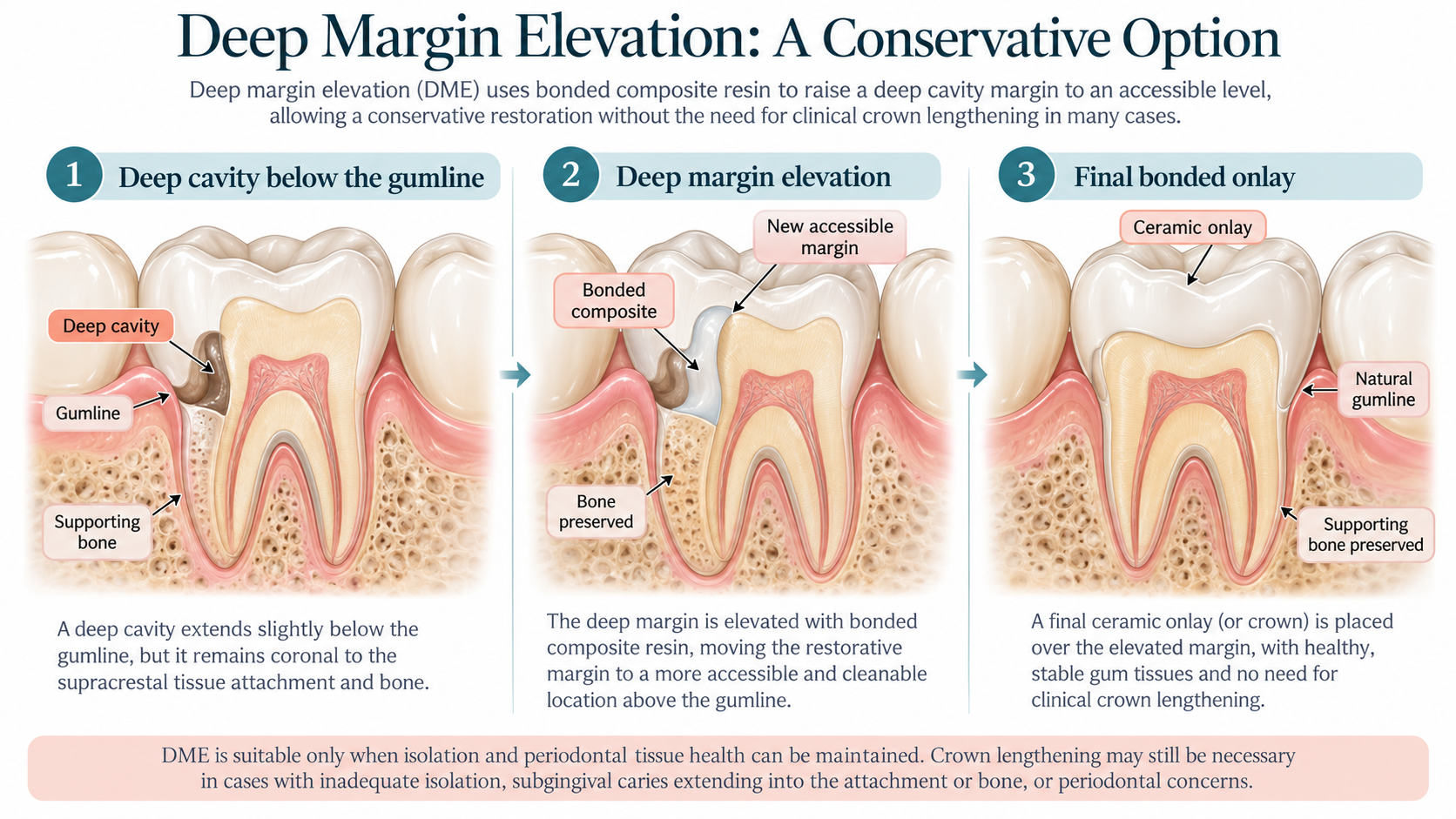
View the full-size deep margin elevation diagram
Deep margin elevation (DME) uses bonded composite resin to raise a deep cavity margin to an accessible level, allowing a conservative restoration without the need for clinical crown lengthening in many cases.
DME is suitable only when isolation and periodontal tissue health can be maintained. Crown lengthening may still be necessary in cases with inadequate isolation, subgingival caries extending into the attachment or bone, or periodontal concerns.
Have you been advised that you need a crown lengthening procedure in order to save a tooth? Sometimes, a cavity or an old restoration extends deep beneath the gumline, making it difficult to restore the tooth predictably. Traditionally, these situations may require a surgical procedure called clinical crown lengthening, in which gum tissue and sometimes supporting bone are removed to expose more of the tooth. While crown lengthening is sometimes necessary, it can alter the gumline, expose additional root surface, and remove healthy supporting bone.
Deep Margin Elevation (DME) offers a more conservative and a slightly different alternative in carefully selected cases. Using adhesive bonding techniques, we can rebuild the deep portion of the tooth with a tooth-colored restorative material, bringing the margin of the future restoration to a more accessible position. This allows us to place and bond an onlay, overlay, or crown more predictably while preserving the surrounding gum tissue and bone.
At Enso Dentistry, our philosophy is preservation over preparation. Whenever clinically appropriate, we favor techniques that conserve healthy tooth structure and minimize surgical intervention. Deep margin elevation is one of the ways we can restore a compromised tooth while respecting its natural biology. Not every deep cavity is suitable for this approach, however. The depth of the defect, the health of the surrounding tissues, and our ability to achieve a reliable seal all help determine whether DME or crown lengthening is the better option.
Our Services
Esthetic dentistry planned around the face, smile, bite, and natural tooth structure.
Tooth-preserving care that respects biology, structure, materials, and long-term function.
Alignment and bite care planned around comfort, stability, function, and restorative goals.
Digitally supported diagnostics and appliances for patients whose care involves airway, sleep, and bite concerns.
Helpful Answers
These short answers are for patients who are comparing cosmetic dentistry, credentials, location, and the kind of care they want.
In carefully selected cases, deep margin elevation can raise a deep restoration margin using adhesive bonding while preserving surrounding gum tissue and bone. Clinical crown lengthening is still necessary in some situations.
An onlay, overlay, or crown can be placed and bonded after the deep portion of the tooth has been rebuilt and the restoration margin brought to a more accessible position.
No. The depth of the defect, the health of the surrounding tissues, and the ability to achieve a reliable seal help determine whether DME or crown lengthening is the better option.